Imagine You Are Lost on a Mountain
Hi! I’m Robby. I spend my days building AI systems, and I get asked all the time: "How does a computer actually learn?"
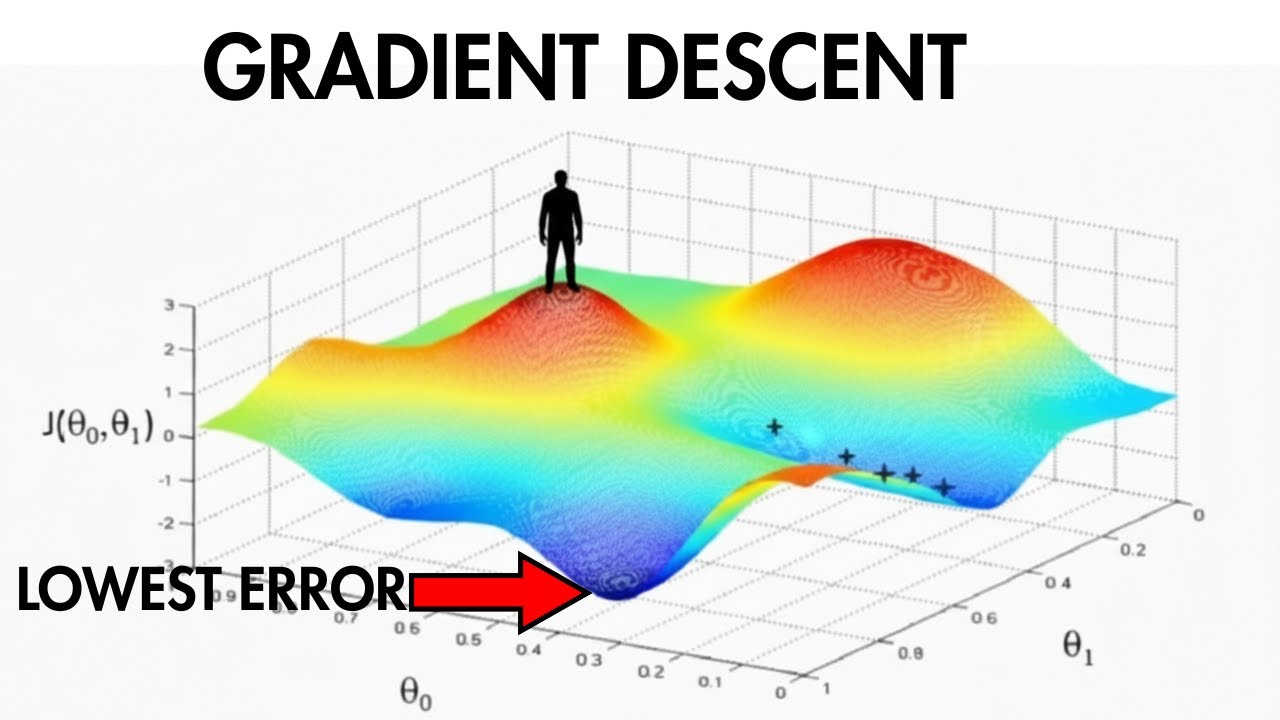
Think about being dropped onto the side of a mountain while wearing a blindfold. You want to reach the very bottom—the valley—but you can’t see where you are going. What do you do?
You would probably use your feet to feel the ground. You’d check which direction slopes downward and take a small step that way. You keep doing this, step by step, until the ground feels flat. You’ve reached the bottom!
This is exactly how AI learns. This process is called Gradient Descent.
Why Does AI Need This?
When a neural network (the "brain" of an AI) makes a prediction, it’s usually wrong at first. It makes a mistake.
We call this mistake the "error." The goal of the AI is to make that error as small as possible. To do that, it acts just like the person on the mountain: it tries to find the path that leads to the lowest point of error.
The Step-by-Step Process
Inside the computer, the AI has thousands of little knobs it can turn. We call these weights.
- The Prediction: The AI makes a guess.
- The Check: It measures how far off it was (the error).
- The Adjustment: It turns its internal knobs (weights) slightly to see if the error gets smaller.
- Repeat: It does this over and over again until the error is as low as it can go.
The Secret Sauce: The Learning Rate
There is one tricky part: how big of a step should the AI take?
- Too Big: If you take giant leaps down the mountain, you might jump right over the valley and end up on the other side. You'll never reach the bottom.
- Too Small: If you take tiny, baby steps, it will take you forever to get anywhere.
In AI, we call this the learning rate. Getting it just right is the secret to building a smart, fast, and accurate model.
Why Mistakes are Good
It sounds weird to say, but for an AI, mistakes are great! Every time the model is wrong, it learns exactly how much it needs to turn those knobs to be more accurate next time.
By feeling the "slope" of its mistakes, the AI slowly turns itself into a tool that can solve real-world problems. The next time you use a smart app, remember: it’s only that smart because it spent a long time practicing how to walk down that mountain.