Hi, I’m Robby!
As a software engineer who builds AI systems every day, I’ve seen it all. You write your code, hit 'train,' and wait for the magic to happen. But sometimes, the magic turns into a headache. Your model either stops learning entirely, or it throws a bunch of errors and crashes.
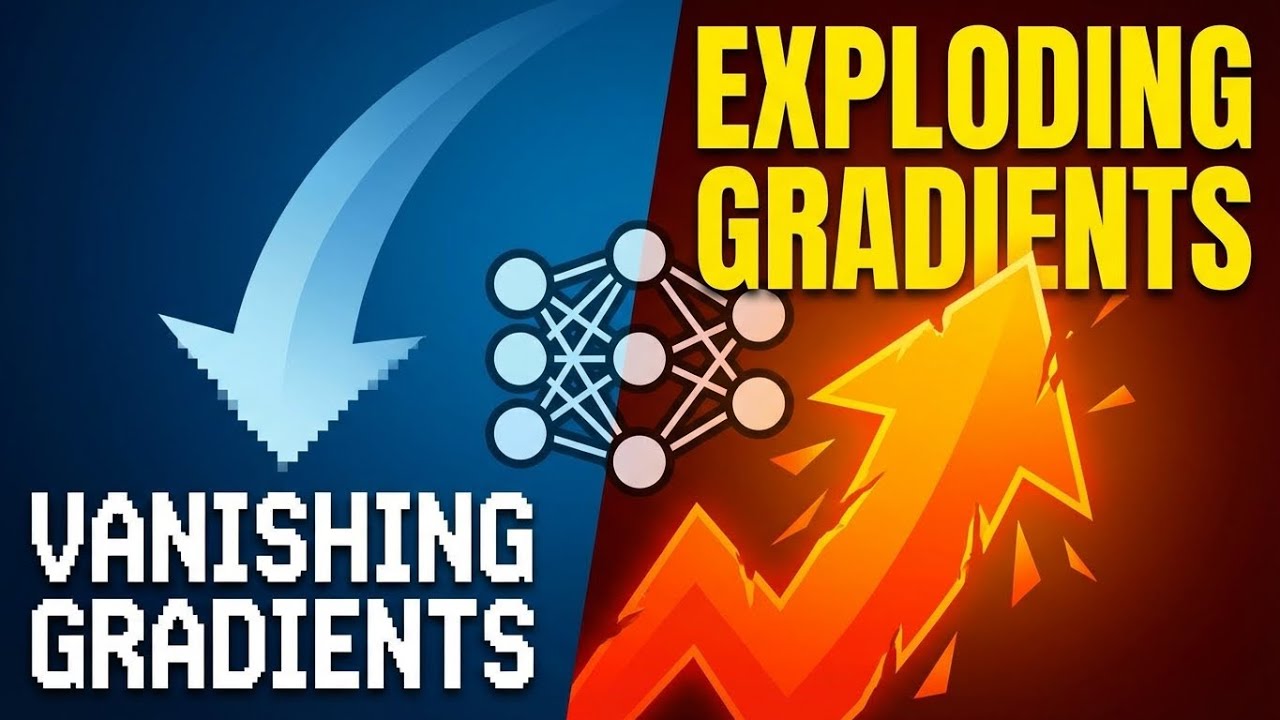
Today, I want to talk about two of the biggest culprits: Vanishing Gradients and Exploding Gradients.
What are Gradients?
Think of a neural network like a student learning to solve a maze. The 'gradient' is like the feedback the teacher gives the student. It tells the network, "You’re going the wrong way, turn left!" or "You’re close, just move a bit more to the right."
In math terms, the gradient tells the network how to change its internal settings (weights) to get a better result. We use a process called backpropagation to send this feedback backward through the network, layer by layer.
The Vanishing Gradient Problem
Sometimes, the feedback gets quieter and quieter as it travels backward. Imagine trying to pass a whisper through 50 people in a line. By the time it gets to the person at the end, they can’t hear anything at all.
In deep networks, this happens when the gradients shrink to almost zero. The early layers of the network never get the message, so they stop learning. Your model stays 'stuck' and never gets smarter.
The Exploding Gradient Problem
This is the opposite problem. Instead of a whisper, think of the feedback turning into a giant megaphone blast. The gradients grow so big that the network's internal settings go crazy.
When this happens, the math breaks. You might see errors like:
- NaN (Not a Number): The computer gets confused because the numbers are too big to handle.
- Infinity: The values grow so large they go off the scale.
- Crashes: Your training run simply quits.
Why Does This Happen?
This usually comes down to two main things:
- Deep Architectures: The more layers you add to your network, the harder it is for the signal to stay the right size.
- Activation Functions: Old-school functions like sigmoid or tanh are designed to squish numbers down. If you use too many of them in a row, they can accidentally squish your signal all the way to zero.
The Bottom Line
Training a neural network is a balancing act. You need your gradients to be just right—not too quiet, and not too loud.
If your model isn't learning, or if it’s crashing with math errors, check your gradients! Understanding these two problems is the first step toward building more stable and powerful AI systems. Happy coding!