Google just released Lyria 3.5, a music model that writes full songs with vocals that actually sound like a person sang them. It is live now in Google Flow Music, Google's AI music studio, and it is the biggest jump the Lyria line has made.
What makes this one interesting is not that it is newer. It is that Google went after the specific things that made AI music instantly recognizable as AI music.
The four things that changed
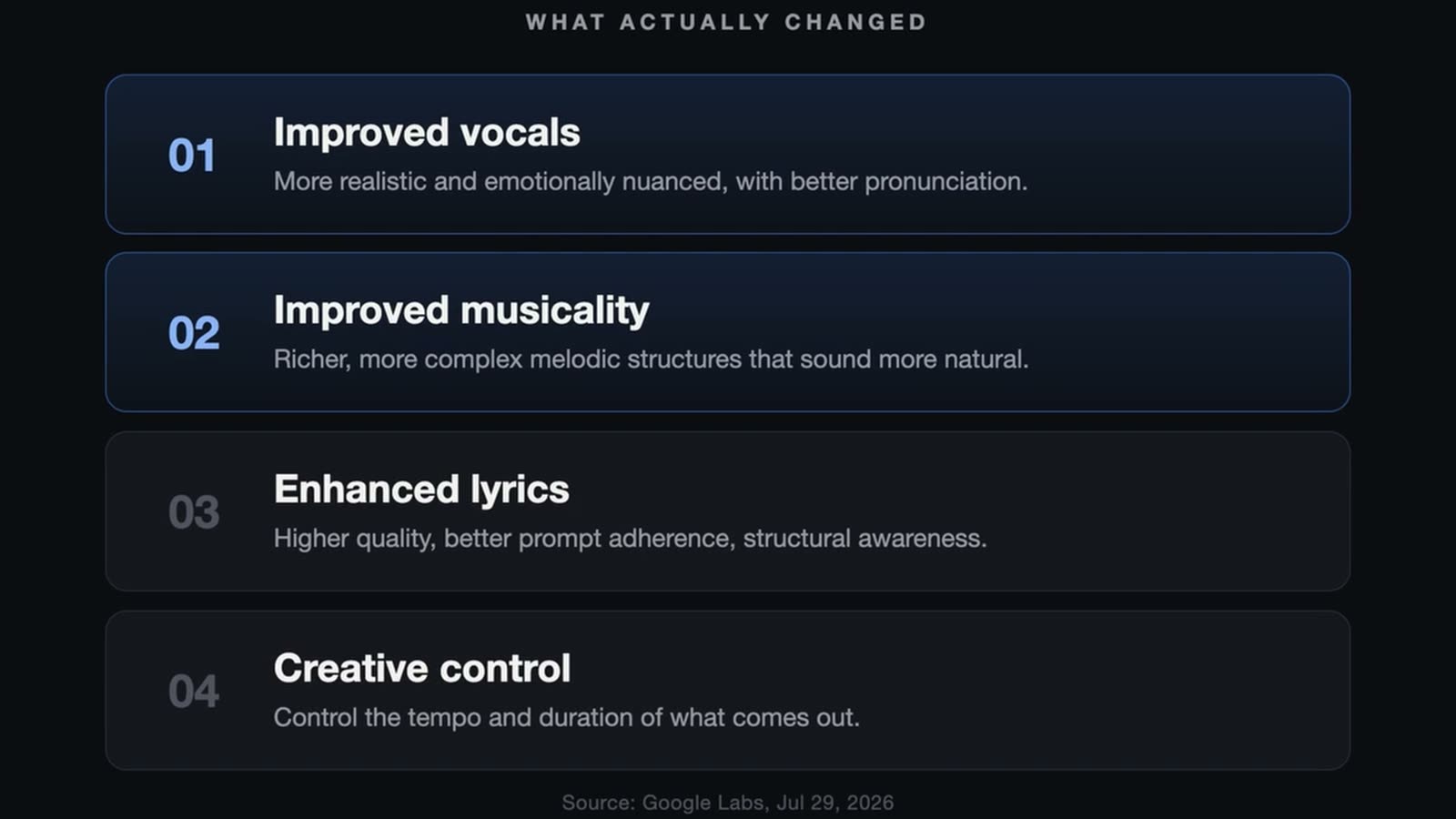
Vocals. More realistic and emotionally nuanced, with better pronunciation. This was the giveaway before. Older models produced technically correct singing that sat flat, with no dynamics and mangled consonants.
Musicality. Richer, more complex melodic structures that sound more natural. The old failure mode was a four bar idea looping until the track ran out. That flat loop feeling is what Google says it fixed.
Lyrics. Higher quality, better prompt adherence, and structural awareness. This is the one that matters most if you are actually trying to write a song.
Creative control. You can now set the tempo and the duration of what comes out, instead of accepting whatever the model decides.
Structural awareness is the real upgrade
The lyrics improvement deserves more than a bullet point, because it changes what you can actually ask for.
Previous models treated a prompt as a vibe. You would ask for a verse, a chorus, and a bridge, and get three minutes of something that drifted between them without ever committing to a shape. Lyria 3.5 has structural awareness, so when you ask for that arrangement it holds the structure and sticks to what you specified.
That is the difference between generating background music and writing a song. A chorus that returns and sounds like the same chorus is most of what makes a track feel finished.
You can try it right now
Lyria 3.5 is live today in Flow Music, so there is no waitlist to sit on. Google's full writeup is on the Google Labs blog.
Worth setting expectations honestly: these are Google's own claims about their own model, and "more emotionally nuanced" is the kind of thing you have to hear for yourself. But the areas they targeted are exactly the right ones, and those are failures you can evaluate in about thirty seconds of listening.