86% of finance executives now say AI skills training is more valuable than an MBA for many new hires. That comes from PwC's 2026 Financial Services Workforce AI Survey: 1,004 leaders at US financial services firms with at least $500 million in revenue, all director level or above, surveyed May 12 to 22, 2026.
The rest of the numbers show how AI is changing who gets hired, who gets paid, and who gets cut.
Who gets paid
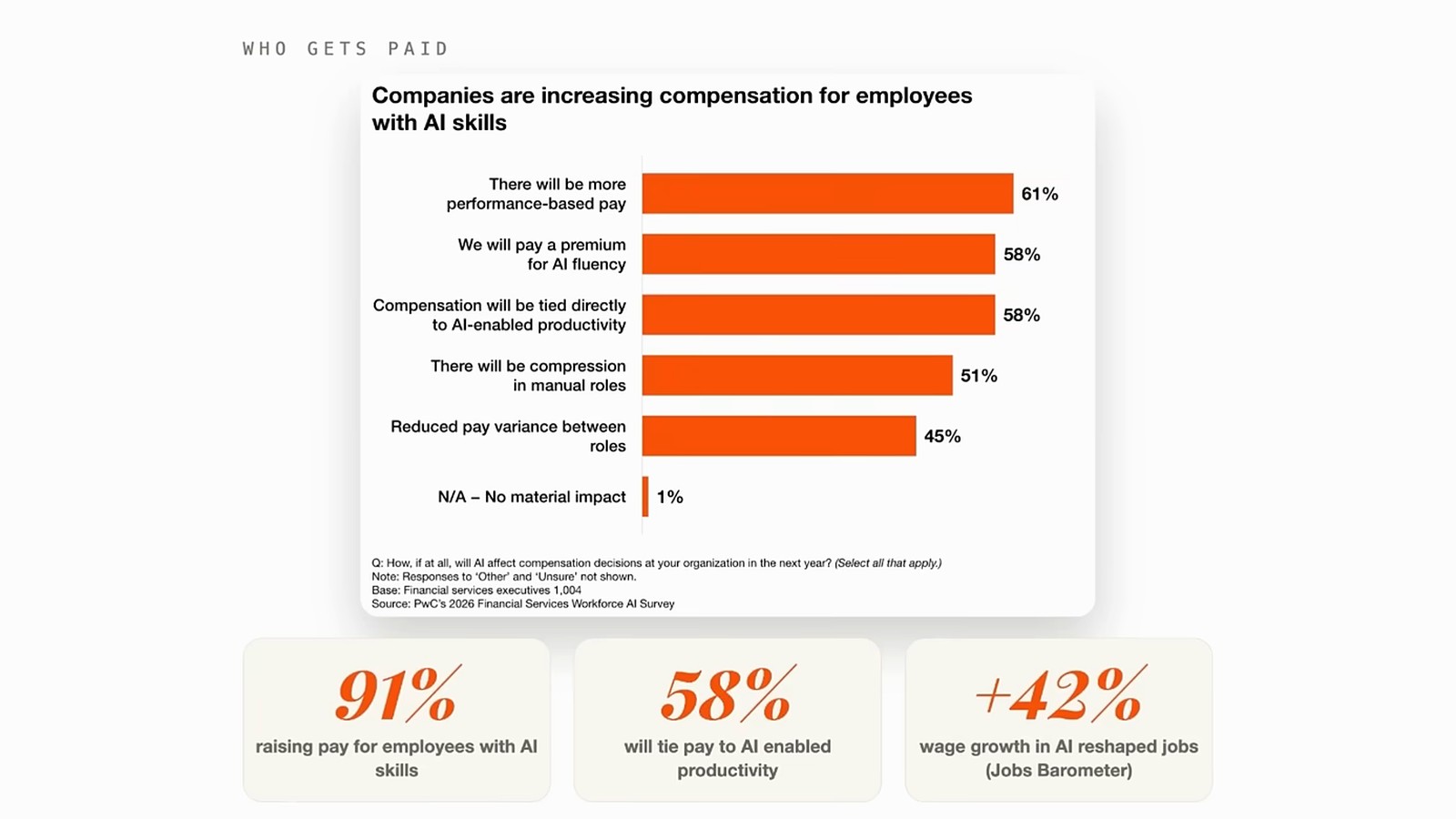
91% of these firms say they are increasing compensation for employees with AI skills. 58% say they will tie pay directly to AI enabled productivity.
PwC's separate AI Jobs Barometer points the same way. Jobs that AI reshapes to need more human expertise (PwC calls them "professionalized") are growing twice as fast in volume and show 42% higher wage growth than jobs that AI makes easier for non-experts to do.
To get the skills, 62% plan to hire people with AI specific skills in the next year, and 61% plan to upskill or reskill the staff they already have.
Who gets cut
Nearly eight in ten executives expect their workforce to shrink by at least 20% over the next five years. When asked which layer of the organization is most vulnerable to AI, 30% named entry-level roles, followed by middle management at 26%.
That entry-level number is a share of executives, not a share of jobs. But it is the clearest signal in the report: the bottom rung of the ladder is the one leaders expect to remove first.
The planning gap
Here is the part that should worry everyone. Only 42% say they have done high-level modeling of AI's effect on labor across the whole company. 77% say most of their AI investments are not delivering measurable ROI. And 90% say employees who use AI tools outside the approved stack create regulatory risk, while 35% say that shadow AI already happens to a significant extent.
So firms are sure the cuts are coming, but most have not designed the workforce that comes after. PwC says it directly: there is a difference between modeling how many people you can cut and designing the workforce you will actually need.
What to take from it
This is a survey of intentions, from one industry, in the US. It is not proof that an MBA has lost its value everywhere. But if you work in or near finance, the signal is consistent: provable AI skill is now something firms say they will pay for, and the roles with the least of it are the ones they expect to cut.