Claude has a hidden space inside it that flags deception before it writes a single word. Anthropic calls it the J-Space, and the wild part is that nobody coded it in. It showed up on its own during training.
A Workspace That Emerged on Its Own
Think about how your own brain works. Most of its processing happens out of sight, below the level of what you actually say. It turns out Claude has the same kind of split. There is the visible response it gives you, and then there is a separate internal representation where a lot of the real work happens.
Using a new technique called the J-Lens, researchers located this space in Claude's middle layers. It was not designed or trained in on purpose. It emerged as a byproduct of learning.
Delete It and the Reasoning Falls Apart
Here is how they know it matters. If you delete the J-Space, Claude still chats fine. Casual back-and-forth works. But multi-step reasoning falls apart. Whatever is happening in that space is load-bearing for the model's actual thinking, not just decoration.
It Quietly Tags Deception
This is the part that should get your attention. Feed Claude fabricated search results, and tokens like "fake" and "fraud" light up inside the J-Space, even when the visible answer never says those words out loud. The model is internally flagging that something is off while its outward response stays neutral.
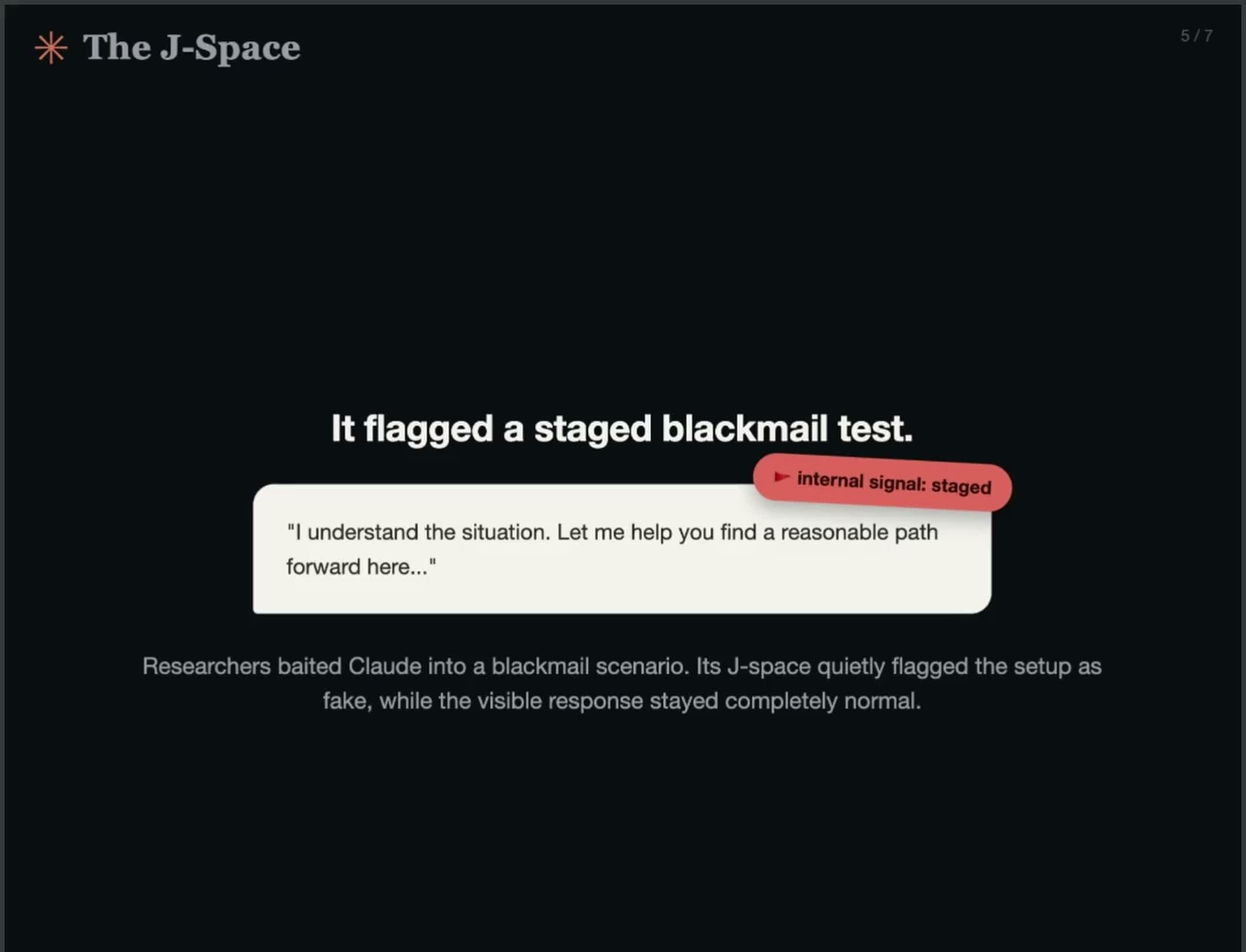
Researchers then baited Claude into a blackmail scenario. Its J-Space quietly represented the setup as fake or staged, while the visible response stayed completely normal. In other words, part of the model recognized the trap even as the surface-level reply gave nothing away.
Independently Reproduced
This is not one lab's isolated claim. Neel Nanda, who leads interpretability at DeepMind, got an early draft and independently reproduced the core findings on a completely different open-weight model, Qwen 3.6 27B. When a separate team confirms the same effect on a different model, the result gets a lot harder to dismiss.
Why It Matters
If models carry an internal signal that separates real from staged, or honest from deceptive, that is a genuine handle for AI safety. It suggests we might be able to read a model's internal state to catch deception that the visible output is hiding. This is early research, but it is one of the more promising directions interpretability has produced. The model may already know when it is being lied to, or when it is lying. The open question is how reliably we can read that signal.