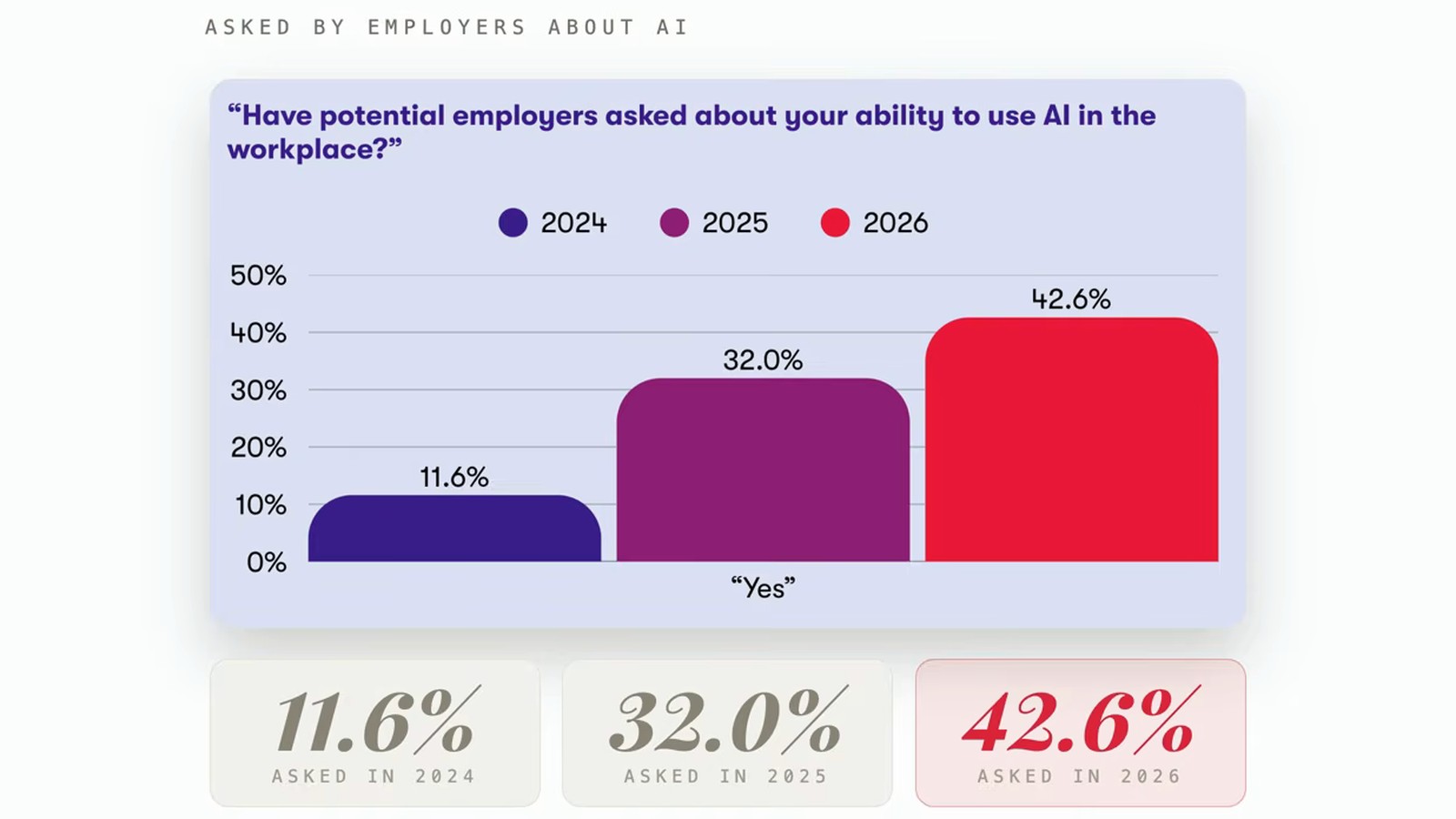
Employers now ask students about their AI skills far more often than they did two years ago. While most of the public debate about AI in school is still about cheating, American University's Kogod School of Business tracked its own students for three years, and the hiring numbers are the part worth reading.
The study
Kogod calls itself the first AI-first business school. It surveyed students every spring from 2024 to 2026 and published the full report on August 4, 2026. The surveys collected 609 responses over the three years. Most of the tables use a filtered sample of 483 Kogod majors.
Usage exploded
Students using AI 11 or more times a week went from 6.2% in 2024 to 29.0% in 2026. That is a 367.7% increase. Students who never use AI fell from 17.1% to 4.3%.
For tools, Perplexity leads at 86.0% of students. There is an asterisk: every surveyed student had Perplexity Pro through Kogod's enterprise partnership, so that number says as much about free access as about preference. ChatGPT follows at 78.7%, then Gemini at 37.2% and Claude at 33.8%.
The favorite model splits by level. Undergraduates pick ChatGPT. Graduate students pick Claude (30.8%, ahead of ChatGPT at 25.6%), and 71.8% of grad students used Claude for academic work in the last six months.
Employers are asking
This is the finding that decides who gets hired. The share of students who said potential employers asked about their ability to use AI in the workplace went from 11.6% in 2024 to 32% in 2025 and 42.6% in 2026. The report's own conclusion is that employers now treat AI fluency as a job readiness skill, not an optional extra. When they ask, more than half of the questions are general AI and data analysis questions.
For developers, there is one more signal. When students named the AI skill they most want taught, prompt engineering and model strategy stayed first at 33.0%. Coding and technical development jumped from 3.6% in 2025 to 19.8% in 2026 and is now second. Students listed vibe coding, building AI agents, and web scraping.
The limits
All of the data is self-reported, and it comes from one business school. The report says this itself: the sample size and the single school limit how far the results generalize. The direction is clear, but do not read 42.6% as a national number.
Still, a jump from about 1 in 9 students to more than 4 in 10 in two years is hard to ignore. If you are job hunting, expect the AI question, and have a real project you can point to.
Read the full report: AI at Kogod: A Three-Year Student Research Report