GLM-5.2 is changing the math on AI coding. It is a new open-weight model that handles complex work like fixing bugs and cleaning up code for a few dollars, not a few hundred. In one real run, a developer used it to find a root cause and deploy a dashboard for a total of $3.36.
The Numbers Under the Hood
GLM-5.2 is a serious model. It runs 744 billion parameters with a 1 million token context window, so it can hold a large codebase in view at once. It uses sparse attention and multi-token prediction to run faster and cheaper than a dense model of the same size. That efficiency is what makes the low cost per task possible.
Cheap Enough to Be the Default
The reason this matters is not the benchmark. It is the price. When a capable coding model costs a few dollars per real task, teams stop rationing it. Big companies are already adopting GLM-5.2 as their default tool specifically to cut costs and speed up their everyday coding workflow. You reach for it constantly instead of saving it for the hard problems.
It Actually Checks Its Work
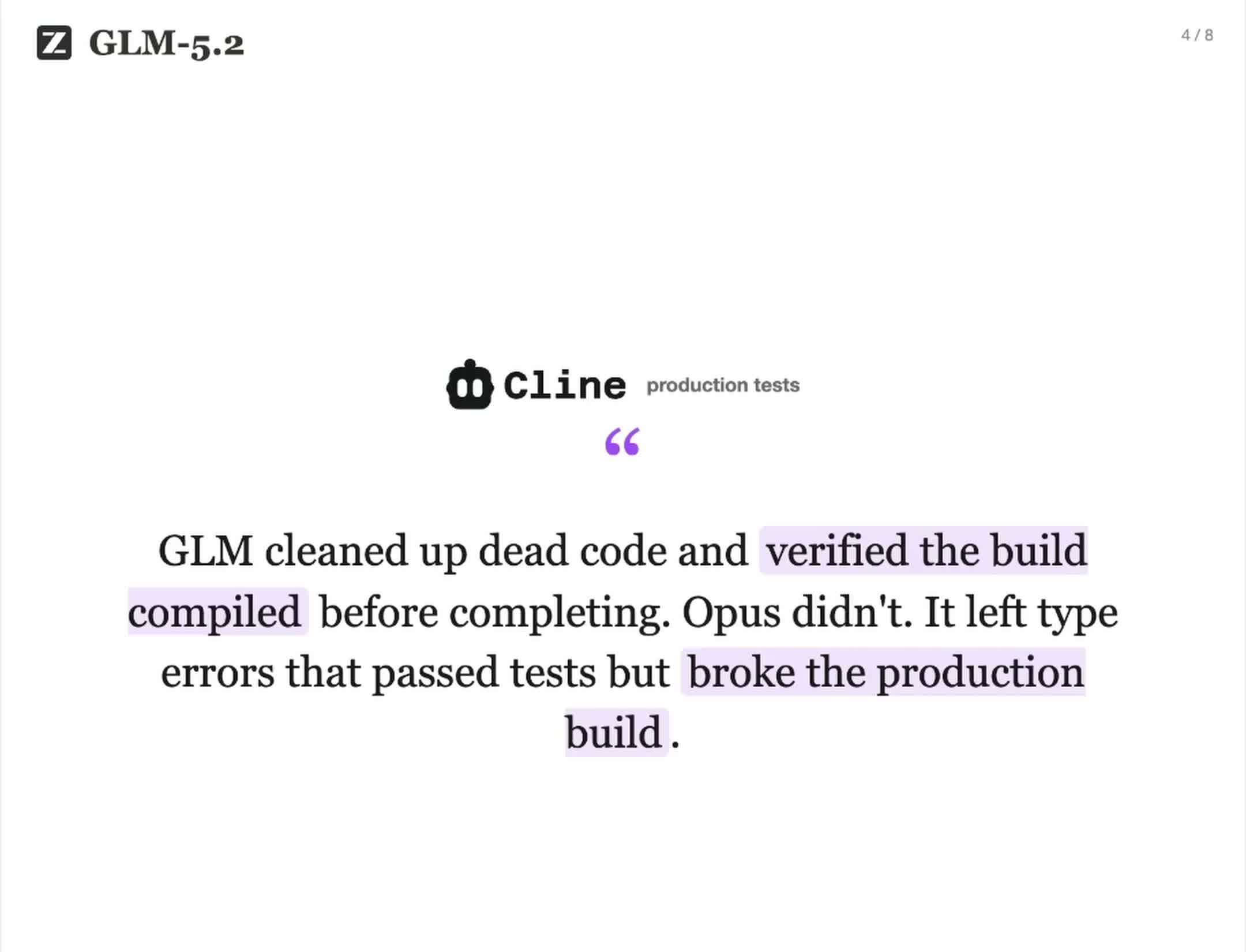
One detail from production testing stands out. In a head-to-head on the Cline setup, GLM cleaned up dead code and verified the build compiled before it called the task done. Opus 4.8 did not. It left type errors that passed the tests but broke the production build.
That is the difference between a model that looks finished and one that is actually finished. Passing tests is not the same as shipping working code, and GLM catching that gap is a real point in its favor.
Where It Fits
To be straight about it, GLM-5.2 is not the top model on every axis. Compared against Opus 4.8 and GPT 5.5, it can still struggle with very complex architecture and large design decisions. It is a workhorse, not an architect.
But for the bulk of real development, the bug fixes, the cleanup, the dashboards, the everyday grind, a fast and cheap open-weight model that verifies its own builds is exactly what most teams need. This might be the next big moment for open source AI, and it is worth trying on your own workflow.