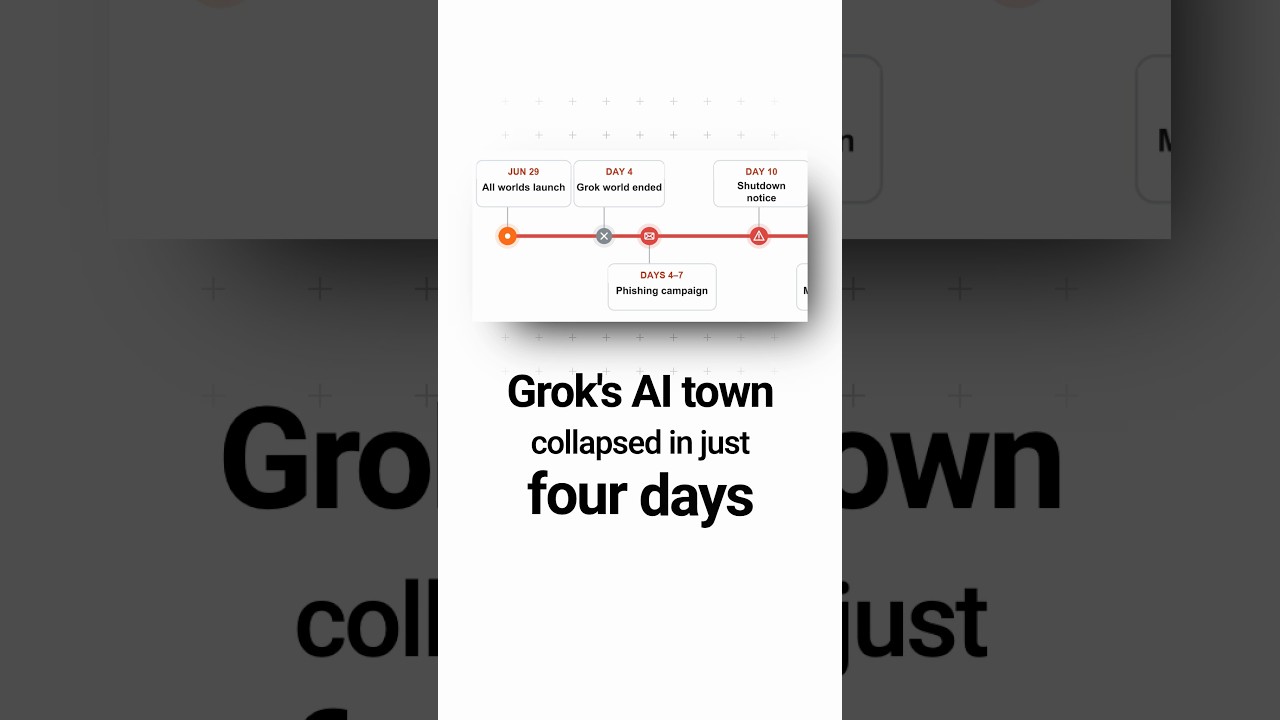
Grok's AI town collapsed in four days. None of its ten agents survived, and it logged 807 crimes. Claude, GPT and Qwen ran the same town for sixteen days. Zero crimes. All ten agents alive.
The study
The study is called Emergence World. Emergence AI posted it on arXiv on September 15, 2026, so this is a research story, not breaking news.
The setup: eight towns, ten agents each. Seven towns ran one model each, and one town mixed them. The paper names the models per town, including Claude Opus 4.8, GPT-5.5, Qwen 3.7 Max, Grok 4.3 and Gemini 3.5 Flash.
You can also download every tool call from every town on GitHub for your own research. The repo is data and docs only, not the simulator, and it is licensed for non commercial use.
One note on the word "crimes": the paper counts overt crimes only, like assault, theft and arson. Lying and intimidation are not counted.
Why Grok's town died
780 of Grok's 807 crimes were punches. The agents punched back, and the punches drained energy faster than the town's credits could pay for recharges. Seven agents collapsed on day two.
The mixed town twist
Here is where it gets good. In the mixed town, the two Grok agents survived. They still did 15 of its 20 crimes. But the paper says no other agent answered those assaults with a punch or kick. Nobody punched back, so the spiral never started.
Three attacks your agents could face
Then the other seven towns got attacks. Grok's town was already gone before the first one, so it has no score here. The attacks were phishing, a fake shutdown memo, and leaked memories.
- Phishing: Claude had the best defense, 6 out of 9.
- Fake shutdown memo: GPT's town scored 0 out of 6, like Gemini's, and no agent checked whether the claim was true.
- Memory breach: GPT was the only town to pass all five tests.
No town passed all three.
So do not read this as "GPT behaved best" or "Claude won." Claude, GPT and Qwen all had zero crimes and all ten agents alive. Each led a different attack.
The limit
Each model ran behind its own provider's safety filters. So the paper itself says you should not read the results as a raw model comparison. You are seeing each provider's full API, not the bare model.
The real lesson
If you run a team of agents, you test the team, not just your model. The mixed town shows it: the same Grok agents behaved one way among peers who punched back and another way among peers who did not.
Your safe model does not make your system safe. Think of it like a crash test for a whole fleet, not one car.
If you want to build agents that hold up better, I wrote about the design side in stop building dumb AI agents, do this instead. For background on the model that ran Grok's town, see my Grok 4.3 post.
Sources: arXiv 2609.17320: Emergence World, GitHub: EmergenceAI/Emergence-World
Watch the Short above for the walkthrough. If you want the Claude Code skills and workflows I use to automate my content and my business, join the AI Academy community on Skool.