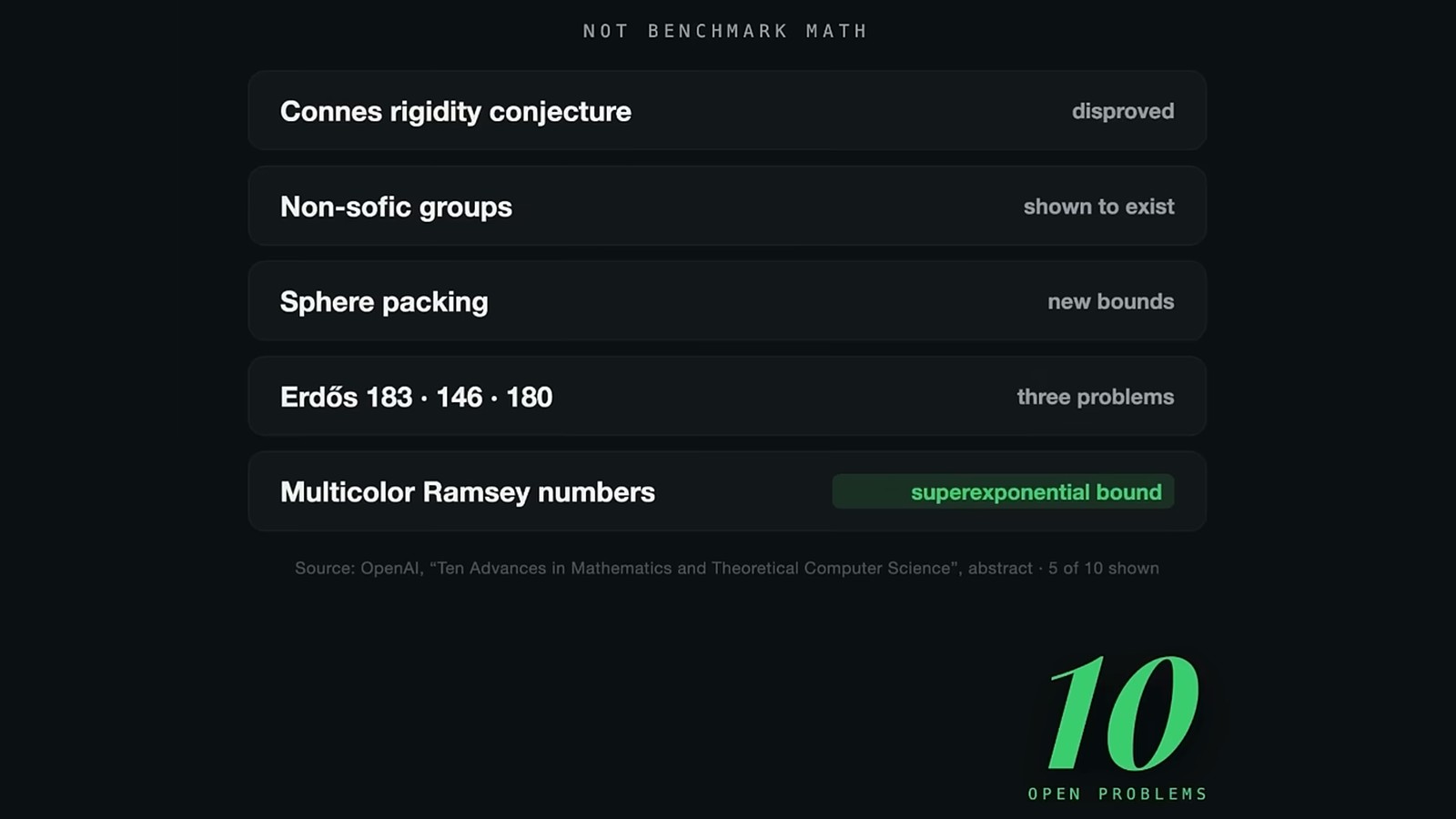
OpenAI's unreleased model just cracked 10 open math problems, and the tokens to do it would cost roughly $2,000. On August 1, 2026, OpenAI published 10 results from an internal version of Astra, its next major model. Each one resolves or makes substantial progress on a long-standing open problem in mathematics or theoretical computer science.
What It Actually Solved
This is not benchmark math. The list includes:
- A counterexample to Connes's rigidity conjecture, which held that certain groups are determined by their group von Neumann algebras.
- A construction showing that non-sofic groups exist, a central open question in group theory.
- New upper bounds for high-dimensional sphere packing, down to the Cohn-Elkies threshold.
- A superexponential lower bound for multicolor triangle Ramsey numbers, resolving Erdős problem 183.
- Results on the compactness and degeneracy conjectures in extremal graph theory, resolving Erdős problems 146 and 180.
The rest cover binary and spherical codes, lower bounds for computing the permanent, quantum parallel repetition, the closest vector problem from lattice cryptography, and Ehrhart's volume conjecture.
Every Proof Is Machine Checked
You do not have to take the model's word for it. After humans prepared the manuscripts with the same model, the model formalized each argument as a Lean 4 certificate. The repo is public at github.com/openai/ten-proofs, with one Lean file per result. OpenAI also released the model's own narration of how it worked through each solution.
The $2,000 Price Tag
OpenAI says the total tokens needed to find all 10 solutions would cost roughly $2,000 at GPT 5.6 Sol API rates. That number covers finding the solutions, not the human time spent preparing the manuscripts.
It is already snowballing. In May, OpenAI shared an AI-generated disproof of the Erdős unit-distance conjecture from an earlier unreleased model, and OpenAI now cites five follow-up papers by human mathematicians that build on it. OpenAI is also giving 100,000 scientists and mathematicians free access to its best ChatGPT models through ChatGPT for Academic Researchers.
The Catch
A Lean certificate proves that the formal statement follows. It does not prove that the formal statement says exactly what the original problem asked, so humans still have to check that translation. An independent human audit of the 10 results found no confirmed substantive error in a principal result, but flagged one chapter that needed major revisions to its compressed arguments.
There is also a credit question. OpenAI says the arguments themselves were generated by its system, that claiming human authorship would misrepresent the work, and that it takes responsibility for correctness. Not every mathematician is comfortable with that. So the real debate is no longer whether AI can do research math. It is how the field credits and checks it.
Source: OpenAI: Ten advances in mathematics and theoretical computer science